
Discreet · contained · regulated disposal
Biohazard Cleanup in Irving, TX
If you are reading this after a death, an injury or a police release, we are sorry. This work is not cleaning — it is decontamination under containment, with regulated waste handling. It is not something a family should be doing themselves.
- Containment and full PPE
- Regulated medical waste disposal
- Unmarked response where requested
Referral service — calls are connected to independent restoration providers. Availability, pricing and licensing are the provider's responsibility.
What biohazard cleanup covers
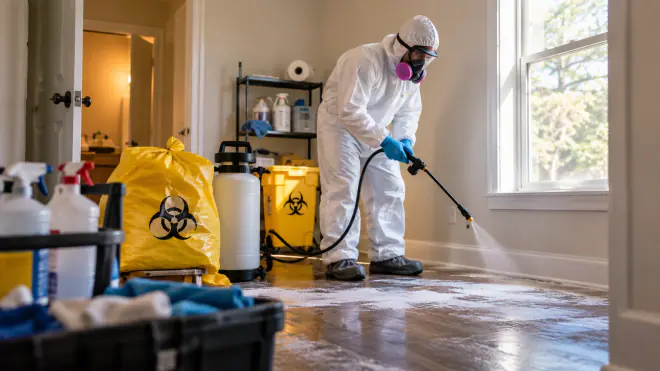
Biohazard cleanup is the containment, removal, decontamination and regulated disposal of materials contaminated with blood, bodily fluids or other potentially infectious material. It is a decontamination process, not a cleaning one, and the difference is not semantic — it determines the method, the equipment, the protective measures and how the waste leaves the property.
Situations it covers include unattended death and decomposition, suicide and homicide scenes after police release, serious accidents and injuries, hoarding conditions involving biological contamination, animal remains or severe animal waste, and contamination from infectious disease. It also covers the aftermath of sewage exposure, which is classed as grossly contaminated water, and it frequently runs alongside structural drying where water was involved and the building has to be dried once the contaminated material is out.
The core technical problem is that bodily fluids penetrate. They do not sit on a surface waiting to be wiped away — they soak through flooring into subfloor, through carpet into pad and slab, down between floorboards and into wall cavities. Proper work involves following the contamination to its full extent and removing material until clean substrate is reached, which frequently means removing more flooring and drywall than the visible area suggests.
Why this is not a family job
People sometimes attempt this themselves out of a sense of duty, or because they do not realise there is a service for it. There are three reasons it is better not to.
Health risk
Blood and bodily fluids can carry bloodborne pathogens including hepatitis B, hepatitis C and HIV. Decomposition introduces additional bacterial hazards and aerosolised material. Protection requires more than household gloves — appropriate PPE, respiratory protection and containment to stop contamination spreading through the property.
Incomplete removal
Household cleaning addresses surfaces. Contamination that has soaked into subfloor, slab or a wall cavity remains, and it announces itself later through persistent odour. By then the property has often been redecorated over it, and the work has to be done twice.
The human cost
This is the reason that matters most. Cleaning the site of a family member's death is traumatic in a way that is difficult to anticipate beforehand, and it is not something anyone should feel obliged to do. There is a profession for this. Using it is not a failure of duty.
Close off the area and keep others out of it, including children and pets. Do not turn on the HVAC if it serves that area. Do not begin cleaning. If police or a medical examiner are involved, wait for the property to be released. Then call when you are ready — there is no need to rush the phone call itself.
How the work is carried out
Discreet assessment
The affected area evaluated and the full extent of contamination traced, including what has penetrated below the surface. Unmarked vehicles and plain uniforms can usually be requested.
Containment
The area sealed off with physical barriers and negative air pressure so contamination and odour do not migrate. HVAC isolated.
Removal of contaminated material
Affected flooring, subfloor, drywall, insulation and contents removed and bagged as regulated waste. Removal continues until clean substrate is reached.
Decontamination
Remaining surfaces cleaned, then treated with hospital-grade disinfectants appropriate to the contamination. Cleaning precedes disinfection — disinfectant over soil does not work.
Odour treatment
Decomposition odour is persistent and embeds in porous materials. Treated with air and surface methods and sealing where required.
Verification
Surfaces verified clean, often with ATP testing. Documentation provided.
Waste disposal
Regulated medical waste transported and disposed of through licensed channels, with documentation.
Reconstruction
Replacing flooring, drywall and fittings that were removed.
Hoarding and severe contamination cleanup
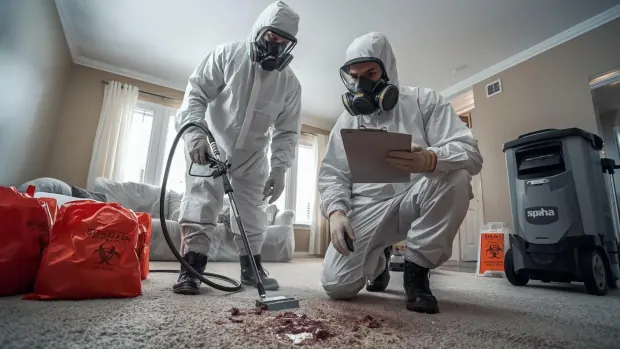
Hoarding situations are handled differently from a trauma scene because the contamination is usually layered on top of an enormous volume of possessions, and because there is almost always a living person whose relationship to those possessions has to be respected.
The biohazard element — animal waste, spoiled food, human waste, pest infestation, mold from long-term moisture — sits underneath the volume problem. Both have to be worked through, and the order matters.
What distinguishes a provider doing this well:
- They work with the resident, not around them. Sorting decisions made with the person wherever possible rather than bulk disposal of everything.
- They look for valuables and documents. Cash, jewellery, deeds and personal papers are routinely found in hoarding environments and should be set aside, not discarded.
- They work in stages rather than clearing everything in one traumatic day.
- They are discreet. Unmarked vehicles, no discussion with neighbours.
- They are realistic about recurrence. Hoarding is frequently connected to underlying mental health conditions, and cleanup without support often leads back to the same situation. A good provider will say so rather than pretend the clean-out is the whole solution.
Cost and who pays
| Factor | Effect |
|---|---|
| Extent of contamination | Surface-level versus material that has soaked into subfloor, slab or cavity. |
| Time elapsed | Longer exposure means deeper penetration and more persistent odour. |
| Materials affected | Tile and sealed concrete can often be decontaminated. Carpet, subfloor and drywall are removed. |
| Area affected | A single room versus contamination that has spread through a property. |
| Regulated waste volume | Disposal is by volume through licensed channels and is a real line item. |
| Odour treatment | Decomposition odour requires extended treatment and sometimes sealing of substrates. |
| Reconstruction | Replacing what was removed — separate scope, often a separate contractor. |
On insurance: many homeowners policies cover biohazard cleanup following a death or traumatic incident on the property, sometimes under a specific provision. Texas also operates a Crime Victims' Compensation Program administered by the Office of the Attorney General, which may assist with crime scene cleanup costs in qualifying circumstances. A provider who handles this work regularly will usually help you identify which routes apply — ask them directly, because families frequently pay out of pocket for something that was covered.
You do not have to handle this yourself.
Call when you are ready. There is no rush on the phone call itself.
FAQ
Biohazard cleanup questions
Do I have to clean this myself?
No. There is a profession for exactly this, and using it is not a failure of duty to the person who died. Beyond the real health risks from bloodborne pathogens and decomposition hazards, cleaning the site of a family member's death carries a psychological cost that is very difficult to anticipate in advance. Call when you are ready — there is no need to rush the phone call itself.
How quickly do I need to act after an unattended death?
Reasonably quickly, because contamination continues penetrating into flooring, subfloor and cavities over time, and odour becomes progressively harder to remove. But nothing can start until police or the medical examiner release the property, so the first step is usually waiting. Once released, earlier is better, both for the cost and for how much of the property can be saved.
Will the neighbours know?
Not from the provider. Unmarked vehicles, plain uniforms and discretion about the nature of the work are standard requests in this field and most providers accommodate them without being asked twice. Say it explicitly when you call so it is arranged in advance rather than managed on arrival.
Does insurance cover biohazard cleanup?
Frequently, yes. Many homeowners policies cover cleanup following a death or traumatic incident on the property, sometimes under a specific provision. Texas also operates a Crime Victims' Compensation Program through the Office of the Attorney General which may assist with crime scene cleanup in qualifying circumstances. Ask the provider — they deal with these routes regularly, and families often pay out of pocket for something that was covered.
How much of my property will need to be removed?
As much as the contamination reached, which is usually more than the visible area suggests. Fluids penetrate through flooring into subfloor, through carpet into pad and slab, and between floorboards into cavities. Removal continues until clean substrate is reached. Non-porous surfaces such as tile and sealed concrete can often be decontaminated and kept; porous materials generally cannot.
Can the smell be fully removed?
In most cases, yes — but only by removing the source material rather than treating the air. Decomposition odour embeds deeply in porous materials, so the sequence is removal of contaminated material, decontamination, then air and surface treatment, then sealing of substrates where odour persists. Treatments applied without source removal mask the smell temporarily and it returns, usually in warm weather.
Still not sure what you are dealing with? Describe it on the phone and we will point you the right way — (469) 960-7264.
Related work
Services that often come with this one
Biohazard work overlaps with other restoration where contamination has reached the structure or where water is also involved.
Where contamination has also involved water, the drying and material-removal principles overlap with the rest of our work. Our Irving water damage restoration service covers that side.
- Sewage Backup CleanupCategory 3 water, handled safely
- Mold Removal & RemediationTexas-licensed remediation rules
- Fire & Smoke Damage RestorationSoot, char and odour
- Structural Drying & DehumidificationDrying what the pump can't reach
Where we cover in Irving
Providers cover all six Irving residential ZIP codes. Discretion and unmarked vehicles can usually be requested.
Talk to someone now
We can take this off your hands.
Call when you are ready. We will connect you with an independent provider equipped for biohazard work in your part of Irving.
(469) 960-7264Referral service — calls are connected to independent restoration providers. Availability, pricing and licensing are the provider's responsibility.