
Standing water · first response
Emergency Water Extraction in Irving, TX
Standing water is the one part of a water loss that gets worse by the minute. Every hour it sits, it spreads further under flooring and wicks higher up the drywall. Extraction is the first job, and it is the one that caps how big everything after it becomes.
- Water spreads continuously until it is removed
- Residential, multi-family and commercial
- All six Irving residential ZIP codes
Referral service — calls are connected to independent restoration providers. Availability, pricing and licensing are the provider's responsibility.
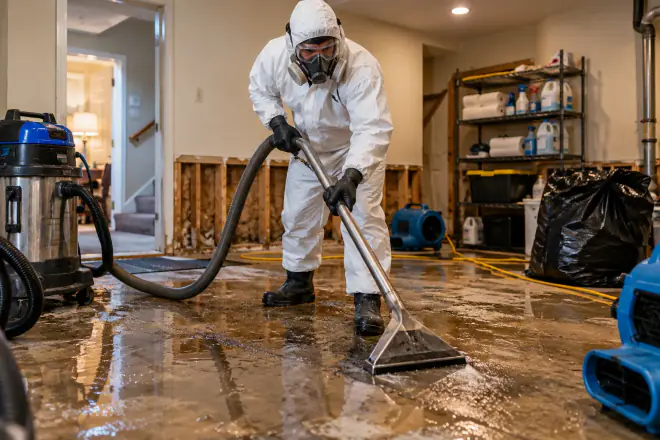
What emergency water extraction actually is
Emergency water extraction is the rapid removal of standing and absorbed water from a building using pumps and extraction units, before drying equipment goes in. It is the first phase of a water damage response, and it is a distinct job from drying — extraction removes the bulk water you can see and a large share of the water already soaked into carpet and pad; drying removes what is left inside the materials afterwards.
The distinction matters commercially as well as technically. A provider who extracts and leaves has done perhaps half the work. Extraction is measured in hours; the drying that follows is measured in days. When you are given a quote, establish which of the two you are being quoted for.
The reason extraction is treated as the emergency phase is simple physics. Water in a building is not static. It follows gravity to the lowest point, spreads laterally across the top of a slab, travels along joists and under cabinet kickboards, and climbs drywall by capillary action at a rate you can watch over a day. Removing the bulk water is what stops that migration. Everything else is cleanup of where it already went.
What the work involves
Extraction is equipment-led, and the equipment used depends on how much water there is and where it is sitting.
Submersible pumps
Used where there is genuine depth — an inch or more of standing water across a room, a flooded commercial space, or a lift pit. A pump moves volume fast but leaves everything below its intake, so it is a first pass rather than a finish.
Truck-mounted extraction
The heavy option. A unit mounted in the vehicle generates vacuum through a long hose run into the property, which means high extraction power without carrying a machine inside. This is what gets used on larger residential losses and most commercial work. On a multi-storey building in Las Colinas, hose length and elevation become the practical constraint.
Portable extractors and weighted extraction tools
For carpet and pad, a weighted tool uses the operator's body weight to compress the carpet against the sub-floor while vacuum pulls water out. This removes dramatically more water from the pad than passing a wand over the surface, and it is one of the clearest tells of whether a crew knows what they are doing. On a water-damaged carpet, surface suction alone leaves the pad saturated.
Controlled release and cavity access
Water trapped in a wall cavity or a sagging ceiling cannot be extracted through the surface. Small relief openings — weep holes drilled low in the drywall, or a controlled release in a bulging ceiling — let trapped water out and give drying equipment access to the cavity. This is deliberate, minimal, and far cheaper than replacing the wall later.
Moisture mapping
Before and during extraction, a competent provider maps where water actually went using a moisture meter and often a thermal camera. Thermal imaging does not see water; it sees the temperature difference evaporation creates, which is how damp is found behind a wall that looks fine. The map determines where extraction stops and where drying equipment is placed.

When you need extraction rather than a mop and a fan
A glass of water on a tile floor is a towel. These are the situations where it is not.
- You can see standing water of any depth across more than a small area, or water that is still arriving.
- Carpet squelches underfoot or releases water when pressed. Carpet pad holds many times its own weight in water and will not give it up to a household vacuum.
- Water has reached more than one room, or crossed a doorway threshold into a hallway.
- Water has gone under cabinets, an island or a built-in — the kickboard space is a reservoir you cannot reach.
- The water came from outside or from a drain. Contaminated water is an extraction and cleaning job, not a drying one.
- A ceiling is bulging. That is trapped water with a structural risk attached, and it needs controlled release.
If water has reached outlets, cords, a water heater's electrical connection or the breaker panel, treat the area as live. Do not enter it to assess, and do not try to reach the panel if you would be standing in water to do it. Say so when you call so the provider arrives prepared.
What produces standing water in Irving properties
Four sources account for most of the standing water we get calls about in Irving.
Supply-line and water-heater failures. A pressurised line does not leak politely — it releases continuously until a valve is closed. A failed water heater in a garage or utility closet can put its whole tank on the floor and then keep going from the supply. Given that Irving's largest construction cohort is 1980s housing, a lot of this equipment is well past the age at which it was ever expected to still be in service.
Hard freezes. Pipes in unconditioned attics and along exterior walls split during a multi-day freeze, and the water usually arrives all at once when the system thaws — frequently while nobody is home. February 2021 produced over half a million winter-storm insurance claims across Texas, concentrated in the Houston and Dallas–Fort Worth areas and overwhelmingly for frozen and burst pipes. See burst pipe water damage.
Appliance overflows. Washing machines, dishwashers, water-filter lines and ice-makers. These tend to produce grey water, which is a different category from a clean supply line and changes how materials are handled.
Storm and surface water. During the March-to-June severe-weather window, water arrives through a hail-damaged roof, around window flashing, or across a threshold when ground water rises. Irving's creek and Trinity floodplain geography makes the last one a real scenario in low-lying parts of the city. Outside water is treated as contaminated — see storm and flood damage cleanup.
What you can safely do before anyone arrives
These genuinely help, and none of them require you to touch the water.
- Close the water main. On an Irving slab home this is usually at the meter box near the street, or a valve on an exterior wall. Find it now, before you ever need it. A water heater normally has its own shut-off on the cold inlet.
- Cut power to the affected circuits — only if the panel is dry and you can reach it without standing in water.
- Photograph and film everything before anything moves. Wide shots of each affected room, then close-ups of the source, the standing water and the damaged contents. Once extraction starts, this evidence is gone permanently.
- Lift contents off the floor. Rugs, cardboard boxes, electronics, anything with a fabric or paper base. Furniture legs on foil or blocks stops wood stain bleeding into wet carpet.
- Open interior doors and cabinet doors to start air circulation, if the water is clean.
- Do not use a household vacuum on standing water, and do not run ceiling fans in a room where the ceiling is wet.
The extraction process, step by step
Safety and source check
Electrical hazards identified, the water source confirmed as stopped, and the water category assessed — clean, grey or contaminated.
Moisture mapping
Meter readings and often thermal imaging to find how far the water actually travelled, including inside wall cavities and under cabinets.
Bulk water removal
Pumps where there is depth, then truck-mounted or portable extraction across the affected floor area.
Deep carpet and pad extraction
Weighted extraction over carpet. Where pad is saturated or the water was not clean, pad is normally removed rather than dried.
Trapped water release
Weep holes or controlled release where water is held in a cavity or a sagging ceiling, plus removal of baseboards where needed for cavity access.
Handover to drying
Air movers and dehumidifiers positioned against the moisture map, with baseline readings recorded so progress can be measured.
Extraction on a typical single-room residential loss is usually a matter of hours. The structural drying that follows runs for several days and is where the job is actually finished.

What drives extraction cost
| Factor | Why it matters |
|---|---|
| Affected floor area | Extraction is largely priced on area covered, not on how dramatic the leak looked. |
| Water category | Clean supply water is straightforward. Grey and contaminated water bring PPE, containment, disposal and cleaning into scope. |
| Depth and volume | Standing depth means pumping before extraction, which is an extra phase and extra equipment. |
| Flooring type | Tile over slab releases water readily. Carpet with pad, engineered wood and laminate hold it and often need removal. |
| Access | Upper floors, long hose runs, lifts and restricted parking all add labour time — a real factor in Las Colinas high-rises. |
| Out-of-hours response | Overnight and weekend callouts are commonly priced differently. Ask before you agree to a visit. |
| Disposal | Removed carpet, pad and contaminated material has to go somewhere, and that is usually a separate line. |
We do not publish dollar figures, because a number given over the phone before anyone has seen the property is a guess. Ask any provider for a written scope that states the affected area, the water category and whether drying is included.
When this is a genuine emergency
Treat it as immediate, not next-day, if any of these apply:
- Water is still arriving and you cannot stop it at the main.
- Water has reached electrical outlets, appliances or the breaker panel.
- A ceiling is sagging or bulging and holding water.
- The water is sewage or came from outside, and people are still living in the space.
- The property is commercial and the water is reaching stock, records or equipment.
- Anyone in the property has asthma, a respiratory condition or a compromised immune system.
Otherwise it is still urgent — just not dangerous. The cost difference between calling at 9pm and calling at 9am the next morning is usually larger than the out-of-hours premium, because what changes overnight is how much material has absorbed water.
If you are not certain which service you need, the symptom guide on our main water damage page matches what you can see to the job that handles it.
Water on the floor right now?
Extraction is the step that stops it spreading further into the structure.
FAQ
Emergency water extraction questions
How long does water extraction take?
For a single room of clean water on hard flooring, often one to three hours on site. Carpet with saturated pad across several rooms, or a commercial space, can take most of a day. Extraction is the fast phase — it is the drying afterwards that runs for days, which is why a provider telling you the whole job is done in an afternoon is describing extraction only.
Do I need extraction if the water has already drained away?
Usually yes. Visible water draining away does not mean the water left the building — it means it moved somewhere you cannot see, typically under flooring, into carpet pad, under cabinets or into the base of the drywall. A moisture meter will tell you in minutes whether there is still water in the materials. If there is, it needs removing and drying, not leaving.
Will extraction ruin my carpet?
It depends on the water, not the extraction. Carpet soaked with clean supply water can often be saved, though the pad underneath is frequently removed because it holds too much water to dry reliably in place. Carpet affected by sewage or flood water is generally removed and disposed of, because porous material that has absorbed contaminated water cannot be reliably decontaminated in situ.
Can I rent an extractor and do this myself?
You can rent a wet vacuum, and for a small clean-water spill caught immediately that may be enough. The limitation is not the machine's existence but its power and what it can reach. A rental unit will not pull water from saturated pad the way weighted extraction does, and nothing you can rent addresses water already inside a wall cavity. The common outcome is a surface that looks dry over a cavity that is not.
What happens to the water you remove?
Clean water is normally discharged to a sanitary sewer connection. Contaminated water — sewage or flood water — has to be handled as regulated waste under the applicable rules, which is one of the reasons Category 3 jobs cost more. Ask your provider how they are disposing of it; a provider who cannot answer clearly is a provider to be cautious about.
Does homeowners insurance cover emergency extraction?
Where the underlying event is covered — a sudden, accidental failure such as a burst pipe — emergency mitigation including extraction is typically part of the claim, and most policies actually require you to take reasonable steps to prevent further damage. Flood is excluded from standard homeowners policies and needs separate flood insurance. Photograph everything before extraction starts and keep every invoice and moisture log.
Still not sure what you are dealing with? Describe it on the phone and we will point you the right way — (469) 960-7264.
Related work
Services that often come with this one
Extraction almost never finishes the job on its own. These are the services that normally follow it, and the causes that most often create the standing water in the first place.
Extraction is one phase of a larger job. For how the whole response fits together — the causes, the symptom guide and the cost factors — start with water damage restoration in Irving, then come back to the phase you need.
- Structural Drying & DehumidificationDrying what the pump can't reach
- Burst Pipe Water DamageSupply lines, freezes and slab leaks
- Sewage Backup CleanupCategory 3 water, handled safely
- Storm & Flood Damage CleanupCreek rise, roof and wind-driven rain
Where we cover in Irving
Extraction providers are matched by ZIP, because travel time is the difference between water sitting for one hour and sitting for four.
Talk to someone now
Standing water does not wait. Neither should the call.
Tell us the address, what failed and whether the water is stopped. We will connect you with an independent restoration provider covering your part of Irving.
(469) 960-7264Referral service — calls are connected to independent restoration providers. Availability, pricing and licensing are the provider's responsibility.