
Stains · sagging · upstairs leaks
Ceiling Water Damage Repair in Irving, TX
A brown ring on a ceiling is not the beginning of a problem — it is the point at which an existing problem became visible. Water has already been sitting above that drywall, in an enclosed cavity, for a while.
- Roof, plumbing and upstairs-unit leaks
- Sagging drywall is a collapse risk
- The stain is rarely under the actual leak
Referral service — calls are connected to independent restoration providers. Availability, pricing and licensing are the provider's responsibility.
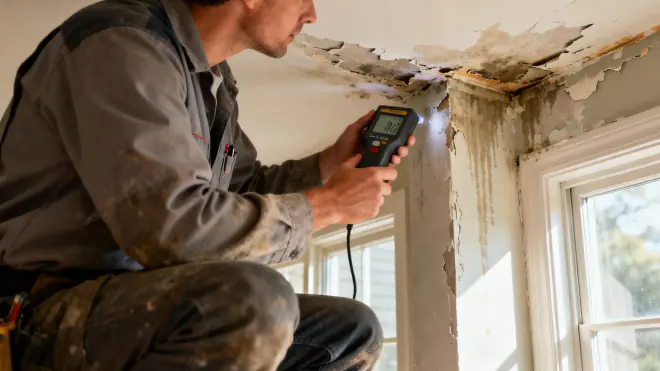
What ceiling water damage repair involves
Ceiling water damage repair is the process of finding the water source above a ceiling, drying the cavity, removing material that cannot be saved, and restoring the ceiling surface. Painting over the stain is not repair — it is concealment, and the stain will come back through because the source is still there and the cavity is still wet.
What makes ceilings different from walls is that the damage happens in a space nobody can see. By the time a stain appears on the finished surface, water has been pooling on top of that drywall, sitting against joists and soaking insulation for some time. The visible mark is the last stage of the process, not the first.
There is also a safety dimension that no other water damage has. Drywall saturated with water becomes extremely heavy and loses its structural integrity. A bulging ceiling holding water does not sag further and further as a warning — it frequently releases the entire load in one go, bringing down drywall, insulation and whatever water was sitting above it. Anyone underneath is in genuine danger.
The stain is rarely directly under the leak
This is the single most useful thing to understand about ceiling leaks, and it is why DIY attempts so often fix nothing.
Water entering a ceiling cavity does not fall straight down. It lands on the top of the drywall or runs along a joist, a pipe, a duct or an electrical cable, and it travels — sometimes several metres — until it finds a low point, a seam or a fixture penetration where it can collect and soak through. The stain forms at that collection point, which can be in an entirely different room from the source.
Three common sources and how they present:
Roof and storm entry
Typically appears after rain and may dry between events. In Irving the sequence is usually spring hail bruising or lifting shingles in March or April, and then rain finding the opening weeks later. Flashing around vents, chimneys and valleys fails more often than field shingles do. See storm and flood damage cleanup.
Plumbing above
Continuous or intermittent depending on fixture use. A shower pan, a toilet flange seal, a supply line in a ceiling cavity or an HVAC condensate line. A stain that grows when a particular fixture is used upstairs is almost always plumbing.
HVAC condensate
Underrated in North Texas and very common in summer. Air handlers in attics produce a great deal of condensate, and a blocked drain line or a failed pan overflows into the ceiling below. It appears in hot weather with no rain, which is often the clue.
What each warning sign actually means
| What you see | What it means | Urgency |
|---|---|---|
| Faint brown or yellow ring | Water has soaked through and partly dried. The ring edge marks the furthest extent. | Investigate promptly |
| Growing or darkening stain | Active, ongoing water entry. | Act now |
| Bubbling or flaking paint | Moisture is pushing the paint film off the substrate. The drywall behind is wet. | Act now |
| Visible sag or bulge | Drywall is holding a pooled volume of water. Structural failure risk. | Evacuate the area immediately |
| Active dripping | Water has found a path through. Often a relief, because it is no longer accumulating. | Contain and call |
| Musty smell, no visible stain | Moisture in the cavity with no surface breach yet. Common with slow roof or condensate leaks. | Investigate |
| Nail pops or seam cracking | Drywall has swollen and moved. Suggests repeated wetting over time. | Investigate |
Get everyone out from underneath, move what you can from the room, and do not poke it to “let it drain.” If a controlled release is appropriate it should be done deliberately, from the side, with a container positioned and the area cleared — not by someone standing directly beneath a saturated panel.
When the leak is someone else's
Around 62% of occupied homes in Irving are rentals, and in the denser parts of the city that figure is far higher — roughly 84% in 75039 and 80% in 75038, where a great deal of the stock is mid-rise and high-rise around Las Colinas. In stacked construction, the single most common ceiling leak is not yours at all. It is a supply line, an overflowed bath, a failed shower pan or a washing machine in the unit above.
What to do, in order:
- Notify building management or your landlord in writing the same day. Not a phone call — an email or portal message that creates a timestamped record.
- Photograph everything before anything is moved or cleaned. Including the date and time.
- Ask management to contact the unit above immediately. You usually cannot, and should not, go and knock yourself in a managed building.
- Record what you lose. Contents damage is normally your own policy's responsibility even when the water came from elsewhere.
- Do not wait for a liability decision to start drying. Whoever ends up paying, the cavity needs drying now.
Three policies can be in play: your renters or condo policy, the upstairs resident's liability cover, and the building's master policy. Which responds depends on where the failure occurred and what the governing documents say. That gets resolved later. The drying cannot wait for it.
How the repair runs
Make safe
Area cleared beneath, contents moved, power to ceiling fixtures isolated. Controlled release if the ceiling is holding water.
Find the source
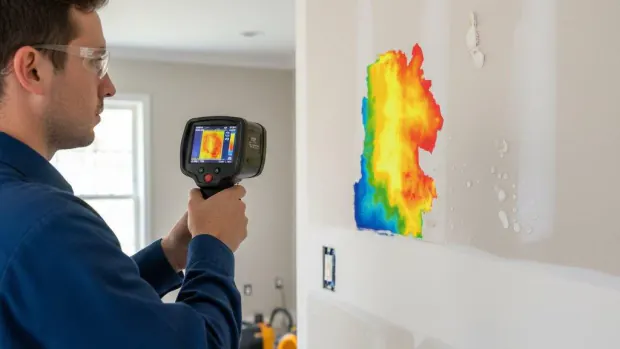
Moisture mapping and thermal imaging to trace back from the stain to the actual entry point, which is frequently elsewhere.
Stop the water
Plumbing isolated, roof temporarily covered, or condensate line cleared — depending on the source.
Open the cavity
Affected drywall and saturated insulation removed. Wet insulation is cheap to replace and holds water against the framing indefinitely, so it comes out.
Dry the structure
Joists, decking and remaining drywall dried to a measured goal, with the cavity opened so evaporation can actually happen.
Rebuild and finish
Insulation, drywall, tape, texture match and paint. Texture matching on an older Irving ceiling is a real skill and worth asking about specifically.
What drives ceiling repair cost
| Factor | Effect |
|---|---|
| Area removed | A small patch versus a full ceiling plane. Partial repairs are cheaper but harder to blend invisibly. |
| Finding the source | An obvious plumbing failure is quick. A roof leak tracking several metres along a joist takes investigation time. |
| Insulation | Saturated insulation above the ceiling is removed and replaced as a matter of course. |
| Height and access | Vaulted and two-storey ceilings need staging or scaffold, which adds labour. |
| Texture match | Matching an existing textured finish is skilled work. A poor match is visible forever under raking light. |
| Mold | If the cavity has been wet long enough for growth, remediation enters scope — and Texas licenses that work past 25 contiguous square feet. |
| Source repair | Roofing or plumbing repair is a separate trade and a separate cost from the ceiling work. |
Where a stain is small and the source is confirmed fixed and the cavity confirmed dry, a patch and repaint may genuinely be all that is required. The order matters: confirm dry first, then finish. Doing it the other way round is how people end up paying twice.
Ceiling stained, bulging or dripping?
Stay out from underneath it and call. A saturated ceiling can release the whole load at once.
FAQ
Ceiling water damage questions
Can I just paint over a water stain on the ceiling?
Only once the source is fixed and the cavity is confirmed dry with a meter — and then you need a stain-blocking primer, because water stains bleed straight through ordinary paint. If you paint over an active leak the stain returns within weeks, and in the meantime the cavity above has stayed wet, which is how a cosmetic problem becomes a mold problem.
How dangerous is a sagging ceiling?
Genuinely dangerous. Water-saturated drywall is very heavy and loses its strength, and a bulging ceiling tends to fail all at once rather than gradually. Clear the room, keep people and pets out, and do not stand underneath to inspect it. If a controlled release is needed it should be done from the side with the area cleared, not by someone directly beneath the panel.
Why is the stain in a different room from the leak?
Because water travels along the top of the drywall, down joists, pipes and ducts until it reaches a low point or a seam where it can soak through. That collection point can be several metres from where the water entered. This is exactly why tracing the source needs moisture mapping and often thermal imaging rather than an assumption that the leak is directly above the mark.
My upstairs neighbour's leak damaged my ceiling. Who pays?
It depends on where the failure happened and what your building's governing documents say — your own policy, the upstairs resident's liability cover and the building's master policy may each have a role. Notify management in writing immediately, photograph everything before anything is touched, and start the drying regardless. The liability question takes weeks to resolve; the wet cavity does not wait for it.
Will the ceiling need to be fully replaced?
Not usually. Drywall that got damp but not saturated, where the source was fixed quickly, can often be dried in place and refinished. Material that is sagging, crumbling, has been wet repeatedly, or shows mold is removed. The practical decision is often about finish rather than structure: a large patch in the middle of a textured ceiling can be harder to disguise than replacing the whole plane.
Could there be mold above my ceiling?
If the cavity has been wet for more than a day or two, it is a reasonable concern — ceiling cavities are dark, enclosed and poorly ventilated, which is a favourable environment. A musty smell with no visible stain is a common early indicator. The cavity gets inspected when it is opened. In Texas, remediation of 25 or more contiguous square feet requires a TDLR-licensed remediator. See mold removal.
Still not sure what you are dealing with? Describe it on the phone and we will point you the right way — (469) 960-7264.
Related work
Services that often come with this one
Ceiling damage is a symptom. These are the usual sources above it, and the work that follows once the cavity is opened.
A ceiling leak is a symptom, and the right next step depends on the source above it. Water damage restoration across Irving covers the full set of causes and what each one leads to.
- Burst Pipe Water DamageSupply lines, freezes and slab leaks
- Storm & Flood Damage CleanupCreek rise, roof and wind-driven rain
- Structural Drying & DehumidificationDrying what the pump can't reach
- Mold Removal & RemediationTexas-licensed remediation rules
Where we cover in Irving
Ceiling leaks from an upstairs unit are the defining water damage scenario in Irving's denser, rental-heavy ZIP codes.
Talk to someone now
Water coming through your ceiling?
Stay out from underneath it and call. We will connect you with an independent restoration provider covering your part of Irving.
(469) 960-7264Referral service — calls are connected to independent restoration providers. Availability, pricing and licensing are the provider's responsibility.