
Supply lines · freezes · slab leaks
Burst Pipe Water Damage in Irving, TX
A pressurised line does not drip — it releases until someone closes a valve. The plumber fixes the pipe. Everything the water touched on its way out is a separate job, and it is the one that costs most if it is left.
- Supply lines, water heaters and slab leaks
- Shut the main off first if you safely can
- Documented for a sudden-and-accidental claim
Referral service — calls are connected to independent restoration providers. Availability, pricing and licensing are the provider's responsibility.
What burst pipe water damage restoration covers
Burst pipe restoration is the removal, drying and repair of the damage a failed water line causes to a building — not the repair of the pipe itself. Those are two different trades, and separating them is the first thing to get straight.
A licensed plumber isolates and repairs or replaces the failed section. A restoration provider deals with everything the released water reached: the flooring it ran across, the drywall it wicked into, the insulation it soaked, the cabinets it got underneath and the ceiling below it if it came through a floor. Some companies offer both; many do one. When you call anyone, establish which you are speaking to, because a plumber who has fixed the pipe and left has not addressed the damage, and a restoration crew cannot legally do the plumbing.
The reason burst pipes produce disproportionate damage is pressure. A supply line is live at mains pressure continuously, so unlike a roof leak that only runs while it rains, it keeps delivering water at full rate until a valve is closed. A line that fails at 2am while the house is asleep, or on the first day of a trip away, can put an enormous volume of water through a building before anyone notices.
Why pipes burst in Irving specifically
Hard freezes in a city not built for them
This is the big one, and it is a North Texas problem rather than a universal one. Irving's climate is humid subtropical — mild winters, hot summers — so the housing stock was never built with cold-climate protection as a priority. Pipes run through unconditioned attics, along exterior walls and through garages. Hose bibs are frequently uninsulated. In a normal winter none of that matters. In a multi-day hard freeze it all matters at once.
The mechanism is worth understanding because it explains the timing. Water expands as it freezes, and the pressure builds between the ice blockage and a closed faucet downstream — which is what actually splits the pipe. But the split often does not release water until the thaw, which is why so many people discover the damage a day or two after the cold passes, sometimes while they are out.
February 2021 is the scale reference. The Texas Department of Insurance recorded 500,196 winter-storm claims through 31 July 2021, 85% of them residential, with roughly $5.8 billion paid to policyholders. State Farm reported that of its 37,790 storm claims logged by 22 February 2021, 28,900 were in Texas, concentrated in the Houston and Dallas–Fort Worth areas and mostly for frozen and burst water pipes.
Supply lines and water heaters at end of life
Irving's peak construction decade was the 1980s, with roughly 20,000 homes built in that period — more than any other decade — followed by the 2000s and 1990s. That means a very large share of the city's housing is running fixtures and connectors that are 25 to 45 years old. Braided washing-machine hoses, toilet supply connectors, icemaker lines and dishwasher inlets all have finite lives and tend to fail suddenly. A water heater tank that corrodes through releases its full contents and then keeps going from the supply.
Slab leaks and Blackland Prairie clay
Dallas County sits on expansive clay soil that swells when wet and shrinks when dry, moving the slab foundations nearly every Irving home is built on. That movement stresses supply lines running within and beneath the slab, and the resulting leaks are the hardest to catch because there is often nothing visible for weeks. The signals are indirect: an unexplained jump in the water bill, a warm patch on a floor, the sound of running water with every fixture closed, damp at the edge of a room, or a section of flooring that begins to lift.
Water pressure and water chemistry
Persistently high incoming pressure stresses every joint and connector in a system, and a failing pressure regulator is a common and cheap-to-fix root cause behind repeat failures. Irving's municipal supply is generally reported as moderately hard, which contributes to scale accumulation over time, particularly in water heaters.
Warning signs before and after a burst
Signs a pipe has already burst
- Water appearing with no obvious source — at the base of a wall, under a cabinet, through a ceiling.
- A sudden drop in water pressure at fixtures.
- Running water audible with every tap and appliance off.
- A water bill that jumps sharply with no change in usage.
- A warm or unusually damp patch on a slab floor.
- Flooring lifting, cupping or separating along a seam.
- During or after a freeze: a tap that runs then stops, or produces nothing at all.
Signs a pipe is about to fail
- Visible corrosion, green staining or mineral crust at a joint or connector.
- A washing-machine hose that is bulging, stiff or cracked at the ends — these are inexpensive and worth replacing on a schedule rather than on failure.
- A water heater past roughly ten to twelve years, particularly one with rust at the base or the fittings.
- Repeated small leaks at different fittings, which usually points at a pressure problem rather than a run of bad luck.
Locate your main shut-off now and make sure it actually turns. On an Irving slab home it is typically at the meter box near the street or on an exterior wall. Cover hose bibs, insulate pipe runs in the attic and garage, open cabinet doors under sinks on exterior walls during a hard freeze, and if you leave town in winter, leave the heating on low rather than off.
What to do in the first ten minutes
Close the main
At the meter box or exterior valve. For a water heater, there is normally a dedicated shut-off on the cold inlet. This stops the supply feeding the leak.
Open the lowest taps
Draining pressure out of the system reduces what is still sitting in the lines above the break.
Cut power if needed
Only if the panel is dry and reachable without standing in water.
Photograph before touching
The failed pipe or fitting itself, then the water, then the damage, room by room. This is what establishes the loss was sudden and accidental.
Call a plumber and a restoration provider
They are different jobs. Both clocks are running.
Keep the failed section of pipe or the failed hose. Do not let it go in a skip. It is physical evidence that the failure was sudden rather than a long-running leak, and that distinction is frequently what determines whether a claim is paid.
The insurance question that decides your claim
Texas homeowners policies generally draw a line between damage that is sudden and accidental and damage that is gradual. A pipe that bursts is normally the former. A fitting that has been seeping behind a cabinet for eight months is normally the latter, and insurers routinely decline it on the basis that it was a maintenance issue the owner should have addressed.
A 2022 federal ruling in the Northern District of Texas upheld an insurer's denial of coverage for water damage caused by gradual seepage, finding the denial reasonable under the policy's exclusions and rejecting the accompanying bad-faith claim. Outcomes turn on the policy wording and the facts, but the direction of travel is clear enough to plan around.
Three things materially improve your position:
- Evidence of suddenness. The failed component, photographs of it in place, and a timestamped record of when you discovered it.
- Evidence of mitigation. Most policies require you to take reasonable steps to prevent further damage. Shutting off the water and getting extraction and drying started is exactly that, and the invoices prove you did it.
- Professional documentation. Moisture readings, a written scope and daily drying logs from the restoration provider. This is the material an adjuster actually works from.
A separate point worth knowing: damage caused by the burst is a different thing from the cost of repairing the pipe. Many policies cover the former and exclude the latter. That is normal and not a sign something has gone wrong with your claim.
How the restoration runs
Source isolated
Water off, pressure drained, and the failed component identified and photographed before removal.
Mapping
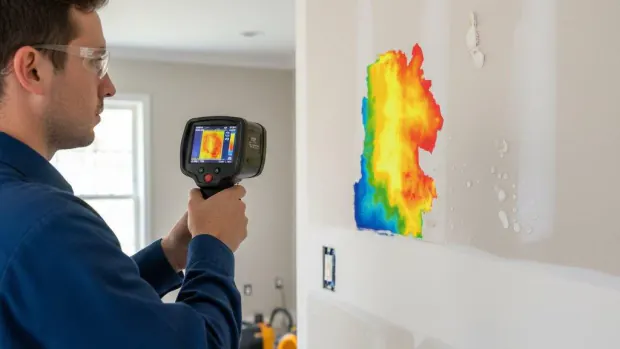
Moisture meter and often thermal imaging to find where the water travelled, including inside walls, under cabinets and into the ceiling below.
Extraction
Standing and absorbed water removed. See emergency water extraction.
Selective removal
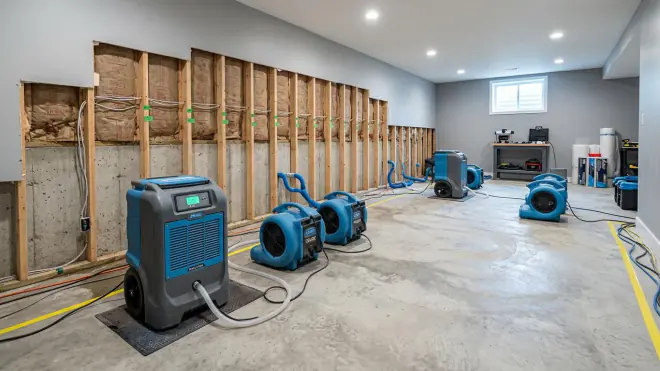
Saturated carpet pad, wet insulation and unsalvageable material out. Weep holes or baseboard removal where water is trapped in a cavity.
Structural drying
Air movers and dehumidifiers to a measured drying goal over several days. See structural drying.
Reconstruction
Drywall, insulation, flooring, trim and paint replaced. Separate scope, often a separate contractor.
Slab leaks: the Irving-specific version of this problem
Almost all Irving housing is slab-on-grade. There is no basement and no crawl space to catch a leak, which means a supply line failing inside or beneath the slab behaves completely differently from one failing in a wall. The water has nowhere obvious to go, so it saturates the ground under the foundation, works up through flooring seams, or simply runs sideways across the top of the slab under the floor covering.
Detection is specialist work — acoustic listening equipment, pressure testing and thermal imaging — and it is usually a plumber's task rather than a restoration provider's. Repair options generally come down to breaking through the slab to reach the failed section, or rerouting the line overhead through the attic and abandoning the section in the slab. Rerouting is frequently chosen because it avoids repeated slab breaks on a system that is failing in multiple places.
From a restoration standpoint, the significant point is that a slab leak has usually been running for a long time before discovery. That means more absorbed water, a higher likelihood of mold in the affected area, and a greater chance an insurer will argue the damage was gradual. Document the discovery carefully and get moisture mapping done properly.
Pipe burst and the water is stopped?
Good — now the restoration clock is the one that matters. Call before the materials absorb more.
FAQ
Burst pipe questions
Who do I call first — a plumber or a restoration company?
Shut the water off first; that stops the loss growing and buys you a moment. Then call both. The plumber repairs the pipe, the restoration provider deals with the water damage, and the two jobs run in parallel rather than in sequence. If you call only a plumber, the pipe gets fixed and the wet building stays wet.
Does homeowners insurance cover a burst pipe in Texas?
Generally yes for the resulting damage, where the failure was sudden and accidental. Policies typically exclude gradual damage from a long-running leak, and many cover the water damage while excluding the cost of repairing the pipe itself. Keep the failed component, photograph everything before anything is moved, and keep every invoice and moisture log. Read your own policy wording — this varies by carrier.
How do I know if I have a slab leak?
The signs are usually indirect because there is often nothing visible. Watch for a water bill that jumped without a change in usage, a warm or damp patch on the floor, running water audible with everything turned off, flooring lifting or cupping, or persistent damp at the edge of a room. A plumber can confirm it with pressure testing and acoustic detection — worth doing rather than guessing, because slab leaks run for a long time before they announce themselves.
Can I prevent pipes freezing in an Irving winter?
Largely, yes, and it is cheap. Insulate pipe runs in the attic and garage, cover hose bibs with insulated caps, open cabinet doors under sinks on exterior walls so warm air reaches the pipes, and let a tap drip during a hard freeze so the system is not sealed. If you travel in winter, leave the heating on low rather than off and consider shutting the main and draining the system.
The burst was in the unit above mine. What do I do?
Notify building management in writing the same day and photograph everything before anything is cleaned. In stacked construction, responsibility depends on where the failure occurred and what your building's governing documents say — your own renters or condo policy, the upstairs owner's policy and the building's master policy may all be in play. Get the restoration started regardless; arguing about liability while the ceiling stays wet helps nobody. See ceiling water damage repair.
How long until my home is back to normal?
Two timelines. Drying normally runs three to five days for a contained loss, longer for hardwood, plaster or slab. Reconstruction — drywall, flooring, trim, paint, cabinetry — depends entirely on how much came out and on contractor and materials availability, and can run from days to many weeks. Ask for both timelines separately, because a provider quoting 'about a week' is usually quoting the drying only.
Still not sure what you are dealing with? Describe it on the phone and we will point you the right way — (469) 960-7264.
Related work
Services that often come with this one
A burst pipe creates work in a predictable sequence. These are the services it leads into, depending on where the water went and how long it ran.
A burst pipe usually triggers two or three of these jobs at once. Our main Irving water damage page maps the whole response, including the symptom guide and what drives the final cost.
- Emergency Water ExtractionStanding water pumped out first
- Structural Drying & DehumidificationDrying what the pump can't reach
- Ceiling Water Damage RepairStains, sagging and upstairs leaks
- Mold Removal & RemediationTexas-licensed remediation rules
Where we cover in Irving
Burst pipe calls spike citywide during a hard freeze, which is exactly when local coverage matters most — every crew in Dallas County is committed at once.
Talk to someone now
Burst pipe in your Irving property?
Tell us what failed and whether the water is stopped. We will connect you with an independent restoration provider covering your ZIP code.
(469) 960-7264Referral service — calls are connected to independent restoration providers. Availability, pricing and licensing are the provider's responsibility.