
Licensed work in Texas · know the rule
Mold Removal & Remediation in Irving, TX
Texas regulates this work. Once mold affects 25 or more contiguous square feet, state law requires a TDLR-licensed remediator — and assessment and remediation generally have to be done by different parties. Knowing that before you hire protects you.
- TDLR licence required at 25+ contiguous sq ft
- Consumer Mold Information Sheet required by law
- Fix the moisture or it returns
Referral service — calls are connected to independent restoration providers. Availability, pricing and licensing are the provider's responsibility.
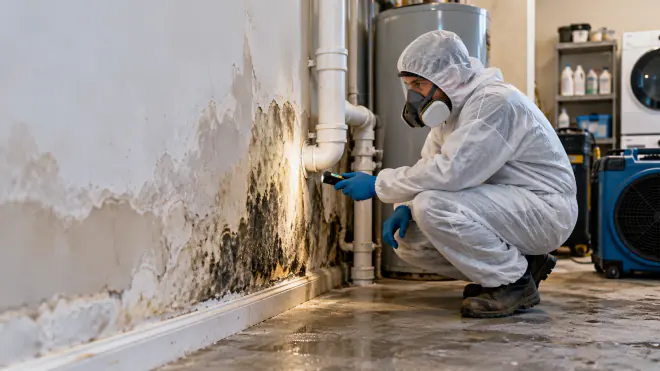
The Texas rule you should know before hiring anyone
Texas is one of the states that licenses mold work specifically, and the detail is genuinely useful to a homeowner rather than just regulatory trivia.
Under the Texas Occupations Code Chapter 1958, with rules administered by the Texas Department of Licensing and Regulation in 16 Texas Administrative Code Chapter 78:
- A licence is required once mold contamination affects a total of 25 or more contiguous square feet for the project. Below that threshold, the work may be performed without a TDLR mold licence.
- Property owners and tenants are exempt on their own property — but that exemption is lost if the person performs mold work for the public as a business, or if the affected area reaches 25 contiguous square feet or more.
- Assessment and remediation are generally kept separate. Texas restricts the same person or company from performing both the regulated assessment and the remediation on the same project, subject to limited exceptions. The purpose is straightforward: the party deciding how much mold there is should not be the party paid according to how much is removed.
- A licensed remediator must give you the Consumer Mold Information Sheet before any mold-related activity begins. If nobody hands you one on a job of that size, that is a signal.
You can verify any mold licence through TDLR's public licence search. Ask for the number, check it, and be cautious of a contractor who is vague about it on a job that is plainly over the threshold. The same scepticism is worth applying to the moisture side: if nobody has explained where the water came from, read how a ceiling leak is traced back to its source before you accept that the problem is understood.
Twenty-five contiguous square feet is roughly a five-foot by five-foot patch. Measuring “contiguous” and “total surface area for the project” is not always obvious, particularly when growth is in a cavity. If you are near the line, treat it as over it and get a licensed assessment.
Why mold grows in Irving properties
Mold needs three things: moisture, an organic food source and a suitable temperature. In an Irving home the food source is everywhere — drywall paper, timber, dust, carpet backing — and the temperature is suitable most of the year. Moisture is the only variable you control, which is why remediation without fixing the moisture source is wasted money.
Water damage that was dried imperfectly
The most common cause we hear about. Surface dried, cavity not. Equipment pulled at day three because the floor felt dry. Wet insulation left in a wall. Rebuilt over damp framing. Each of these produces a hidden reservoir that supports growth for months. See structural drying for how the drying standard is supposed to be verified.
Slow leaks nobody saw
A supply connector seeping behind a cabinet, a shower pan failing slowly, a toilet flange weeping. These run for months at low volume, which is close to ideal conditions — constant moisture, no flooding to prompt anyone to investigate.
HVAC condensate and humidity
Underrated in North Texas. Air handlers in attics produce a lot of condensate, and a blocked drain line overflows into the ceiling cavity. Oversized units cool quickly without running long enough to dehumidify, leaving the property cool and clammy. Summer humidity alone, combined with poorly ventilated spaces, can support growth without any leak at all.
Roof and envelope leaks
Spring hail damage in March and April, rain finding the opening in May and June, and growth starting in a dark, unventilated attic or ceiling cavity where nobody looks until there is a smell.
Slab and foundation moisture
Blackland Prairie clay moves with moisture, stressing slabs and the lines beneath them. A slab leak can run undetected for a very long time, and extended dampness under flooring is a reliable precursor to growth.
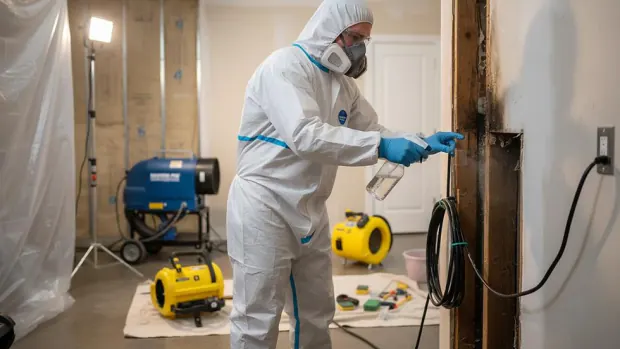
How to tell whether you have a mold problem
- A persistent musty, earthy smell — often the first and sometimes the only sign. Trust it, particularly if it is stronger in one room, in a cupboard, or when the HVAC starts.
- Visible growth in black, green, white or orange, often in a patch or along a seam. Colour does not identify the species and does not tell you the risk.
- Staining or discolouration on drywall, ceilings, around windows or at the base of walls.
- Peeling, bubbling or cracking paint or wallpaper, which indicates moisture behind.
- Warping, cupping or soft spots in flooring or trim.
- Symptoms that improve when you leave the property and return when you come back — congestion, irritated eyes, headache, worsening asthma.
- Condensation on windows or interior walls, indicating high indoor humidity.
- A history of water damage in the property, especially one handled without professional drying.
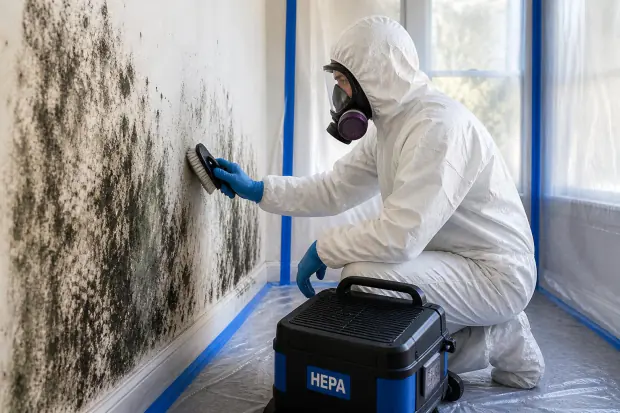
Do not brush, scrape, vacuum or blow air at visible growth. Disturbance releases spores into the air and spreads the problem to places that did not have it. Do not run fans in the room and do not run the HVAC if the growth is near a return. Close the door and leave it alone until it has been assessed.
How proper remediation runs
Assessment
For work at or above the licensing threshold, a licensed mold assessor evaluates the extent and produces a remediation protocol. This is the separate-parties rule in action.
Find and fix the moisture
Non-negotiable and first. Remediation over an unfixed leak is guaranteed to fail.
Containment
The work area sealed with sheeting, and negative air pressure established with HEPA-filtered equipment so spores are not pushed into clean areas.
HVAC shutdown
So the system does not distribute spores through the property during the work.
Removal of affected material
Contaminated porous material — drywall, insulation, carpet — removed and bagged inside containment. Growth on porous material is not cleaned off; the material comes out.
Cleaning and HEPA work
Non-porous surfaces cleaned and treated. HEPA vacuuming and air filtration throughout the containment.
Drying
The structure dried to a measured goal so conditions no longer support growth.
Clearance
Post-remediation verification, normally by the independent assessor rather than the remediator. Then reconstruction.
Four things people get told that are not true
“Just spray it with bleach.”
Bleach is largely ineffective on porous materials. It is mostly water, and on drywall or timber the water carries into the material while the chlorine stays on the surface — so the surface discolours and looks clean while the growth underneath keeps going, now with added moisture. On non-porous surfaces it has a role. On drywall it does not solve the problem.
“You need a test to know if you have mold.”
If you can see it or smell it, you have it, and testing changes nothing about what needs doing. Testing has real value in specific situations: establishing the extent of hidden growth, post-remediation clearance, and disputes. It is not a prerequisite for dealing with visible growth, and a contractor who insists on an expensive test before quoting is worth questioning.
“Black mold is toxic mold.”
Colour does not identify species, and the popular “toxic black mold” framing oversimplifies things considerably. What matters practically is that there is active growth and a moisture source feeding it. Any significant indoor growth should be addressed regardless of colour, and the remediation approach does not change based on which species it is.
“Remediation fixes it.”
Remediation removes what is there. If the moisture source remains, it returns — usually within months, in the same place. Any proposal that does not identify and address the water source is incomplete, however thorough the removal sounds.
Mold and insurance
Mold coverage is one of the more restricted areas of a Texas homeowners policy, and the limits are often lower than people expect.
- Mold resulting from a covered sudden event — such as a burst pipe that was reported and mitigated promptly — is often covered, frequently with a specific sub-limit well below the policy's main limit.
- Mold from a long-running leak or deferred maintenance is routinely excluded on the basis that it was gradual and preventable.
- Mold following a flood falls under flood insurance if you hold it, not under the homeowners policy.
- Delay in reporting weakens the claim. An insurer can argue that mold which developed because the loss was not reported promptly is your responsibility rather than theirs.
The practical lesson is consistent: report water losses promptly, get professional drying with documented moisture readings, and keep the records. The drying log that proves the structure was dried to a measured standard is the single best protection against a later mold dispute.
Found growth or a persistent musty smell?
Do not disturb it. Call and ask the provider for their TDLR licence number before any work begins.
FAQ
Mold removal questions
Do I need a licensed mold remediator in Texas?
Once the affected area reaches 25 or more contiguous square feet, yes — Texas Occupations Code Chapter 1958 requires a TDLR mold remediation licence. Below that threshold the work can be done without one. Property owners and tenants are exempt on their own property, but lose that exemption at the 25 square foot mark or if they do mold work for the public as a business. You can verify any licence through TDLR's public search.
Why can't the same company assess and remediate?
Texas generally prohibits the same person or business from performing both the regulated assessment and the remediation on the same project, with limited exceptions. The reason is conflict of interest: the party determining how much mold exists and writing the protocol should not be the party whose payment depends on how much work that protocol creates. It also means your clearance verification comes from someone independent of the crew that did the removal.
Can I remove mold myself?
For a small area — under the 25 square foot threshold — on a non-porous surface such as tile or a bath surround, often yes, with proper precautions and after fixing the moisture source. Beyond that, no. Growth on porous material means the material comes out rather than gets cleaned, removal without containment spreads spores through the property, and at 25 contiguous square feet the law requires a licensed remediator anyway.
Does bleach kill mold?
On hard non-porous surfaces it has a role. On porous materials such as drywall and timber it largely does not work: bleach is mostly water, the water soaks into the material while the chlorine stays on the surface, so you discolour the visible growth while adding moisture to what is underneath. It is one of the most common and most counterproductive pieces of DIY advice.
How much mold is dangerous?
There is no agreed threshold, and sensitivity varies enormously between people. Anyone with asthma, allergies, a respiratory condition or a compromised immune system can react at levels others do not notice. The practical position is that visible indoor growth should be addressed regardless of amount or colour, and that the regulatory line at 25 contiguous square feet is about who may do the work, not about where harm begins.
Will mold come back after remediation?
Only if the moisture comes back. Mold needs moisture, and removing growth without fixing the water source means it returns in the same place, usually within months. This is why any credible remediation proposal starts with identifying and fixing the source — a leak, a drainage problem, HVAC condensate or chronic humidity. If a quote does not mention the moisture source at all, ask why.
Still not sure what you are dealing with? Describe it on the phone and we will point you the right way — (469) 960-7264.
Related work
Services that often come with this one
Mold is always downstream of a moisture problem. These are the sources it usually follows from, and fixing them is what stops it returning.
Mold is nearly always downstream of a water problem that was not dried properly. The Irving water damage overview explains the drying standard that prevents it, and the causes that most often lead here.
- Structural Drying & DehumidificationDrying what the pump can't reach
- Ceiling Water Damage RepairStains, sagging and upstairs leaks
- Storm & Flood Damage CleanupCreek rise, roof and wind-driven rain
- Burst Pipe Water DamageSupply lines, freezes and slab leaks
Where we cover in Irving
North Texas humidity plus a moisture source is the recipe everywhere in Irving, but the sources differ by housing type and age across the city.
Talk to someone now
Mold in your Irving property?
Call and we will connect you with an independent provider. Ask them for their TDLR licence number — for work over 25 contiguous square feet, Texas requires one.
(469) 960-7264Referral service — calls are connected to independent restoration providers. Availability, pricing and licensing are the provider's responsibility.