
The phase that actually finishes the job
Structural Drying & Dehumidification in Irving, TX
Pumping the water out is not drying. The moisture left inside drywall, framing, subfloor and slab is what causes the second round of damage — the staining, the warping and the musty smell that turns up three weeks later. Drying is measured work, and it takes days.
- Air movers plus dehumidification, not fans alone
- Daily readings and drying logs
- Dry means a meter reading, not a guess
Referral service — calls are connected to independent restoration providers. Availability, pricing and licensing are the provider's responsibility.
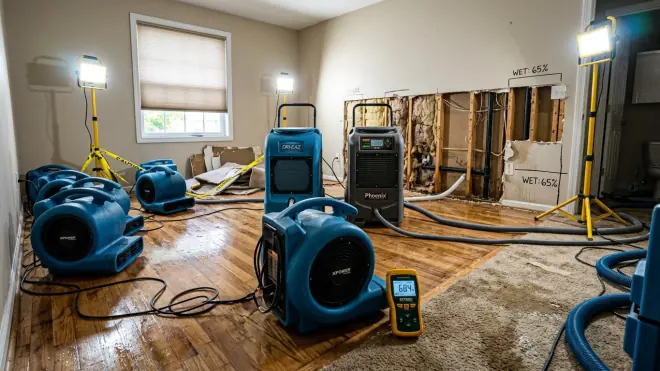
What structural drying is, and why it is a separate job
Structural drying is the controlled removal of moisture from building materials — drywall, framing, subfloor, insulation, concrete slab — using air movement and dehumidification, continued until moisture meter readings reach a documented dry standard. It begins where extraction ends.
The reason it is treated as a distinct phase is that extraction and drying remove water from completely different places. Extraction removes free water: water you can see, water sitting on the slab, water held in carpet and pad. Drying removes bound water: the moisture that has been absorbed into the structure of the material itself. No pump reaches that. Only evaporation does.
This is also the phase that gets skipped, because it is the slow and invisible one. The floor looks fine, the room smells fine, the homeowner is exhausted and wants everyone out of the house. Three weeks later the baseboard is cupping, there is a dark line along the bottom of the wall and a musty smell in the hallway, and a drying job has become a mold remediation job.
How drying actually works
Drying is evaporation management, and it has three levers that have to be balanced. Get one wrong and the whole process stalls.
Air movement
Wet material sits inside a thin layer of saturated air clinging to its surface, and while that layer stays put, evaporation effectively stops. Air movers are angled low across surfaces to strip that boundary layer away and keep evaporation running. Placement is deliberate — angle, spacing and direction around the room — not simply pointing fans at the wet patch.
Dehumidification
Air movers push moisture out of materials and into the air, which raises the humidity in the room. Without something to remove that moisture from the air, you have simply relocated the problem — and the water will condense back onto cooler surfaces elsewhere in the building. Dehumidifiers pull it out and discharge it to a drain. This is the single most common DIY failure: fans running in a closed room with no dehumidifier, moving water from the floor into the air and then into the ceiling.
Temperature and containment
Warmer air holds more moisture, so a controlled temperature speeds evaporation. The drying area is usually contained — doors closed, plastic sheeting where needed — so the equipment is working on a defined volume rather than the whole house. In an Irving summer, the outside air is often more humid than the air being dried, which is exactly why opening the windows is the wrong instinct for most of the year.
Specialty drying
Dense and layered materials — hardwood, engineered flooring over slab, plaster, concrete, and cavities between a floor and a ceiling below — do not dry with ambient airflow because the wet surface is not exposed. These need targeted systems: floor drying mats that pull moisture up through hardwood, injection drying that forces air into a wall or ceiling cavity through small ports, or negative-pressure systems under flooring. It is slower and costs more, which is why providers will sometimes recommend removing the material instead. Ask for both options and the reasoning.
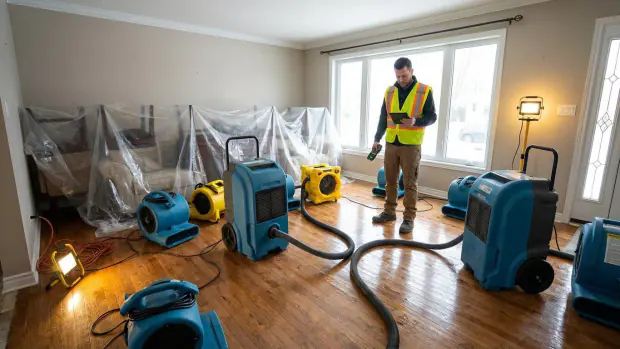
What “dry” actually means
Dry is not a judgement call, and this is the most useful thing a homeowner can understand about the process. Dry is a number.
A provider establishes a drying goal by measuring an unaffected area of the same material elsewhere in the building — a wall in a room the water never reached, for instance. That reading becomes the target. The affected materials are then dried until they reach it, with readings taken at the same marked points every day so progress is comparable.
This is why daily monitoring matters and why you should ask for the logs. A proper drying record shows, for each day: the ambient temperature and relative humidity, the readings at each monitoring point, and what was adjusted. It tells you whether drying is actually progressing or has stalled, it tells you honestly when the equipment can come out, and it is the documentation your insurance adjuster will want to see. A provider who pulls equipment on day three without readings is guessing, and so are you.
“Can you show me the drying goal you set, which unaffected material you took it from, and today's readings against it?” Any competent provider answers that in under a minute. It is the single best question for separating a professional operation from a van with some fans in it.
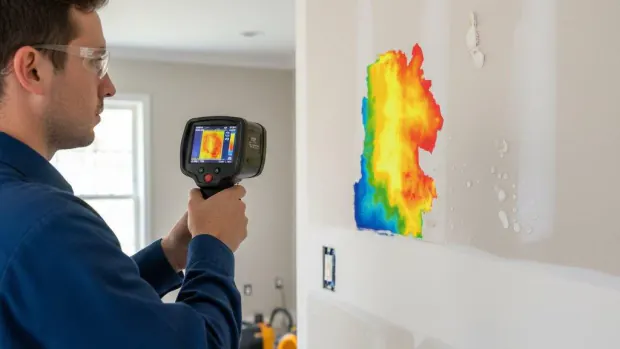
How long drying takes
Three to five days is the common range for a contained residential loss caught early. That is a guide, not a promise, and the honest answer is that it takes as long as the readings say it takes.
What extends it:
- Dense materials. Hardwood, plaster and concrete slab release moisture slowly. Slab drying in particular can run well beyond a week.
- Cavity water. Moisture inside a wall or between floors has no exposed surface to evaporate from until the cavity is opened or injection drying is used.
- Delay before equipment went in. Material that has been saturated for days has absorbed far more than material wet for hours.
- Humid conditions. Irving summers are humid, and that raises the load on the dehumidification side.
- Equipment removed too early. Pulling units at day three because the surface feels dry restarts the problem silently.
Equipment runs continuously, including overnight. It is noisy and it uses electricity — both are normal and both are worth tolerating, because an interrupted drying cycle is a failed one. If you cannot stay in the property while it runs, say so early; it affects planning.
The drying process, step by step
Mapping and baseline
Moisture readings taken across affected and unaffected materials. The unaffected readings set the drying goal. Monitoring points are marked so every later reading is taken at the same spot.
Material decisions
What can be dried in place and what has to come out. Saturated carpet pad, wet insulation and contaminated porous material are usually removed rather than dried.
Equipment placement
Air movers angled across wet surfaces, dehumidifiers sized to the volume of the contained area, and specialty systems for hardwood, cavities or slab where needed.
Daily monitoring
Readings at every marked point, plus ambient temperature and humidity. Equipment repositioned as some areas reach goal before others.
Verification and removal
Equipment comes out when readings meet the drying goal — not on a fixed schedule. The final readings are documented.
Handover for reconstruction
Anything removed during drying is replaced. That is a separate scope and frequently a separate contractor.
What drives drying cost
| Factor | Effect on the job |
|---|---|
| Number of units | Air movers and dehumidifiers are typically charged per unit per day. A larger or wetter area needs more of both. |
| Number of days | Set by how long readings take to reach the drying goal, not by a fixed schedule. |
| Material type | Hardwood, plaster and slab need specialty drying — slower and more equipment-intensive than open drywall. |
| Cavity access | Injection drying or opening walls for cavity access adds labour, and adds reconstruction afterwards. |
| Containment | Sheeting off the drying area reduces the volume being conditioned and usually shortens the job. |
| Monitoring visits | Daily attendance to read, log and reposition. Priced in, and worth paying for. |
| Power | Equipment runs around the clock on your meter. Modest against the job, but not nothing. |
The trade-off worth discussing openly with a provider is dry-in-place versus remove-and-replace. Specialty drying of a hardwood floor may cost more than the flooring is worth; sometimes removal is the cheaper and more certain route. Ask for both numbers and the reasoning rather than accepting the first recommendation.
The five mistakes that cause a second claim
- Fans with no dehumidifier. Moves water from the material into the air, where it condenses somewhere cooler. The classic DIY outcome.
- Opening the windows. Intuitive, and usually wrong in North Texas. For much of the year you are importing humid outside air into a space you are trying to dry.
- Stopping when the surface feels dry. Surfaces dry first and fastest. The cavity behind them does not.
- Leaving wet insulation in a wall. It holds water against the framing, dries extremely slowly and is cheap to replace. It should come out.
- Rebuilding too early. Closing a wall over damp framing hides the problem rather than solving it, and it becomes a mold discovery during the next renovation.
Every one of these produces the same end state: a surface that looks finished over material that is still wet. That is how a drying job becomes mold remediation — which in Texas is licensed work once it affects 25 or more contiguous square feet.
Not sure if your walls are actually dry?
A moisture reading settles it in minutes. Ask the provider for the drying goal and the daily log.
FAQ
Structural drying questions
How long will the drying equipment be in my house?
Commonly three to five days for a contained residential loss caught early, but the honest answer is: until the moisture readings meet the drying goal. Dense materials such as hardwood or concrete slab can take considerably longer. Ask your provider on day one what goal they have set and from which unaffected material they took it, then ask to see the readings each day.
Can I turn the equipment off at night because of the noise?
Please don't. Drying is a continuous process — switching equipment off lets moisture redistribute through the materials overnight and you effectively restart part of the cycle each morning. It genuinely extends the job and therefore the cost. If the noise is unmanageable, raise it with the provider: sometimes units can be repositioned or quieter equipment substituted, but switching them off is not the answer.
Why can't I just open the windows?
Because for much of the Irving year the air outside holds more moisture than the air you are trying to dry. Opening up brings that humidity in and works directly against the dehumidifier. Drying is done in a contained space on purpose. There are specific cool, dry days where ventilation helps, but it is a judgement a provider makes from the readings, not a default.
How do I know it is actually dry and not just dry on the surface?
Moisture meter readings, taken at the same marked points each day and compared against a drying goal set from unaffected material elsewhere in the building. Touch tells you nothing about what is behind the surface. Ask for the drying log — a provider doing this properly will have one and will share it without hesitation, and your insurer will want it anyway.
Does drying remove mold that has already started?
No. Drying stops mold growing further by removing the moisture it needs, but it does not remove growth that already exists — and disturbing it with air movers can spread spores around the property. If visible growth or a persistent musty smell is present before drying starts, that needs assessing first. In Texas, remediation of 25 or more contiguous square feet requires a TDLR-licensed remediator.
Will drying save my hardwood floor?
Sometimes. Specialty floor drying mats pull moisture up through the boards and can save a floor caught early, particularly solid hardwood. Engineered flooring is less forgiving because water delaminates the layers, and laminate generally does not survive at all. The decision is partly economic: specialty drying has a real cost, and on a modest floor replacement is occasionally cheaper and more certain. Ask for both options costed.
Still not sure what you are dealing with? Describe it on the phone and we will point you the right way — (469) 960-7264.
Related work
Services that often come with this one
Drying sits between removing the water and putting the building back together. These are the services either side of it, and the problem it exists to prevent.
Drying is the phase most often cut short. If you want the sequence it sits inside, the full water damage restoration process for Irving walks through extraction, drying and reconstruction in order.
- Emergency Water ExtractionStanding water pumped out first
- Mold Removal & RemediationTexas-licensed remediation rules
- Ceiling Water Damage RepairStains, sagging and upstairs leaks
- Burst Pipe Water DamageSupply lines, freezes and slab leaks
Where we cover in Irving
Drying runs for several days with daily monitoring visits, so a provider based near your ZIP is a practical advantage rather than a marketing line.
Talk to someone now
Still damp after the water is gone?
That is the point at which drying equipment matters most. Call and we will connect you with an independent restoration provider covering your part of Irving.
(469) 960-7264Referral service — calls are connected to independent restoration providers. Availability, pricing and licensing are the provider's responsibility.